
To relieve chronic morning lower back stiffness and prevent recurring lumbar strain, perform a 10-minute gluteus medius and deep-core activation routine using non-slip fabric hip resistance bands four to five times per week. Strengthening weak hip abductors and gluteal stabilizers prevents pelvic drop and removes excess mechanical load from your lumbar spine.
When your lower back aches first thing in the morning or after hours at a desk, the natural instinct is to stretch or rub the sore lumbar muscles directly. Yet clinical physical therapy research consistently shows that the lower back is often the overworked victim of sleepy, underactive glutes and deep abdominal stabilizers.
Top 5 Tools for Lower-Back Decompression, Glute Activation & Mobility
Build a complete at-home physical therapy and back recovery studio featuring lumbar decompression, breathable activewear, non-rolling fabric resistance bands, and high-density floor support:
| Role & Pick | Key Benefit & Specs | Price & Reader Offer |
|---|---|---|
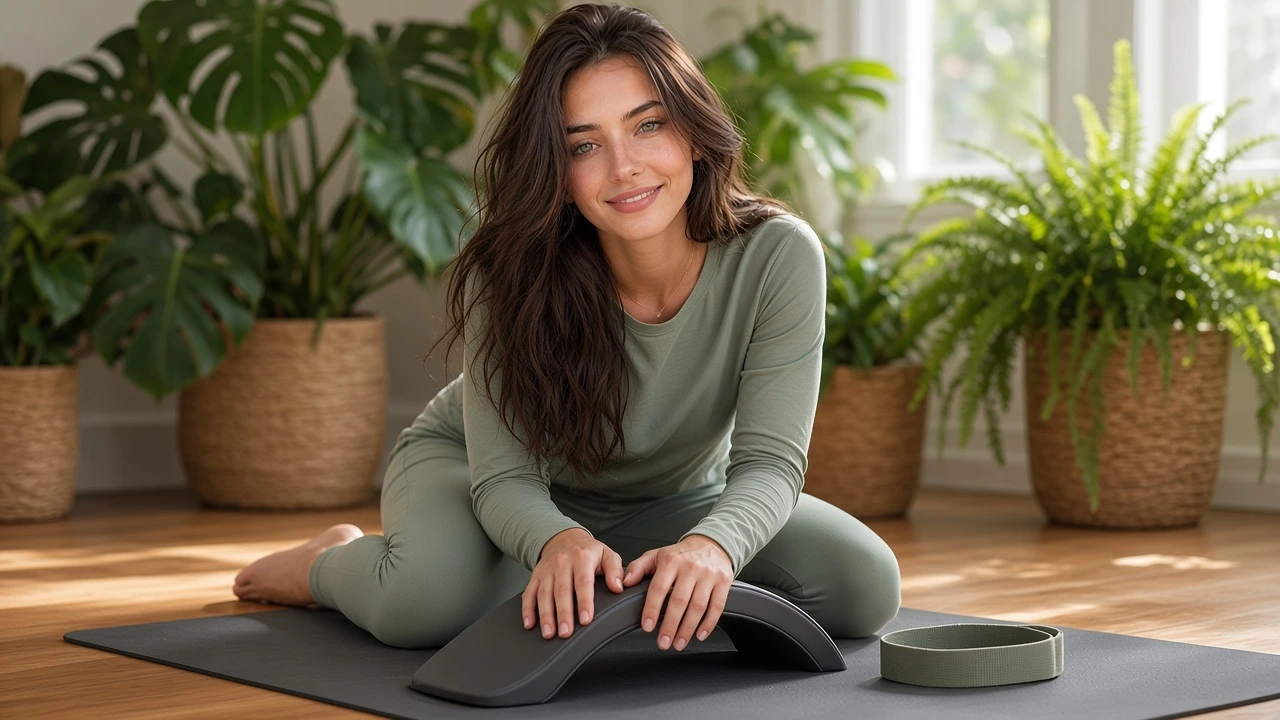
| #1 Hero Gadget (Lumbar Decompression): Back Arch Lumbar Massager & Spine Stretcher |
Health: Multi-level lumbar traction and acupressure arch that decompresses stiff lower-back discs in 5 minutes a day. Wealth: Saves hundreds on recurring chiropractic or physical therapy clinic visits. Relationships: Restores daily comfort and shared activity with your partner. |
$79.00 $71.10 + Free Tracked Shipping with code HEALTH10 (or bundle 2+ items for 15% OFF with BUNDLE15)Shop Back Arch Stretcher → |
| Best Non-Slip Mobility Activewear: LOREN Vented 2-Piece Mesh Leggings Yoga Set |
High-waisted, breathable mesh compression leggings and vented top that prevent resistance bands from chafing bare skin while keeping your core supported. | $36.00 $32.40 + Free Tracked Shipping with code HEALTH10 (or $97.75 for Stretcher + Yoga Set with BUNDLE15)Shop LOREN Yoga Set → |
| Best Non-Slip Hip & Glute Bands (Amazon): 3DActive 3-Piece Non-Slip Fabric Hip & Glute Resistance Bands Set |
3 progressive tension levels (Light, Medium, Heavy) woven with inner non-slip latex grip strips that never roll, pinch skin, or snap during bridges and squats. | Check current price on Amazon View on Amazon → |
| Best Myofascial Release Roller (Amazon): TriggerPoint GRID 1.0 Multi-Density Foam Roller (13-Inch) |
Patented hollow-core EVA foam with 3D Distrodensity zones to release tight hip flexors, IT bands, and thoracic stiffness before band work. | Check current price on Amazon View on Amazon → |
| Best Spine-Cushioning Floor Mat (Amazon): Gaiam Essentials Thick 10mm Yoga & Exercise Mat |
Extra-thick 10mm (2/5-inch) high-density NBR foam protects sensitive tailbones, knees, and lumbar vertebrae on hardwood or tile floors. | Check current price on Amazon View on Amazon → |
Why Do Weak Glutes and Core Muscles Cause Morning Lower Back Pain?
Weak gluteus medius, gluteus maximus, and transverse abdominis muscles force your lower lumbar spine (L4 to L5 and L5 to S1) to absorb stabilization forces meant for your hips and pelvis. Over time, prolonged sitting and hip-flexor tightness trigger gluteal amnesia, leaving your lower back muscles chronically tight, fatigued, and stiff upon waking.
Your pelvis acts as the foundation of your spine. According to a landmark clinical study indexed by the National Institutes of Health (NIH) on PubMed examining gluteus medius weakness in people with chronic low back pain, patients with chronic non-specific lower back pain exhibit significantly weaker gluteus medius strength, a higher prevalence of pelvic drop (Trendelenburg sign), and greater gluteal and paraspinal palpation tenderness than pain-free controls. In addition, a randomized controlled trial in the NIH PubMed Central database (PMC4713798) demonstrated that combining gluteus muscle strengthening with lumbar segmental stabilization exercises produces a significantly greater reduction in low back pain disability scores and stronger lumbar stability than lumbar exercises alone.
Similarly, the Cleveland Clinic’s clinical guide to lower back pain emphasizes that strengthening both the abdominal core and the muscles surrounding the hips is one of the most effective conservative ways to stabilize the spine and prevent recurring flare-ups.
If you already follow our morning mobility habit in do this when you wake up for less back pain, adding five to ten minutes of targeted resistance-band glute activation right afterward locks in that mobility so your lower back stays supported all day.
Why Are Fabric Hip Bands Better Than Thin Latex Loops for Back Rehab?
Wide, woven fabric resistance bands outperform thin rubber latex loops because their 8-centimeter (3.15-inch) surface area distributes outward tension evenly across your thighs without rolling up, pinching skin, or snapping mid-rep. Consistent lateral tension keeps your knees tracking safely over your toes during glute bridges, clamshells, and lateral walks.
Anyone who has tried doing squats or clamshells with a cheap, wafer-thin latex band knows the frustration: within three repetitions, the rubber curls into a tight cord that digs painfully into your bare legs or slides straight up to your knees, breaking your concentration and form.
A dedicated 3-piece fabric loop kit such as the 3-Piece Non-Slip Fabric Hip & Glute Resistance Bands Set ($18.65–$51.15) is engineered specifically for lower-body rehabilitation and core sculpting:
- 3 Progressive Resistance Levels in One Kit: Start your morning spine warm-up with the Light band, progress to the Medium band for banded glute bridges, and graduate to the Heavy band as your hip stability grows stronger.
- Inner Non-Slip Latex Grip Strips & Breathable Leggings: Soft polyester knit is woven with internal latex grip threads so the band stays anchored just above your knees, especially when worn over high-waisted, breathable activewear like the LOREN Vented 2-Piece Mesh Leggings Yoga Set ($36.00).
- Pairing With Lumbar Traction & Percussion Recovery: Before or after your 10-minute band session, spending 5 minutes on the Back Arch Lumbar Massager & Spine Stretcher ($79.00) gently decompresses stiff lumbar discs, while the RENPHO Deep Tissue Percussion Muscle Massager on Amazon releases stubborn trigger points in the gluteus medius and piriformis.
What Is the Best 10-Minute Resistance Band Routine for Lower Back Relief?
The most effective 10-minute lower back relief routine combines four spine-neutral exercises: banded posterior-tilt glute bridges, side-lying banded clamshells, standing lateral band walks, and core-braced banded dead bugs, performed on a cushioned 10mm mat with slow, controlled 3-second contractions and zero lumbar overarching.
Before placing the band around your legs, lay out a supportive surface like the Gaiam Essentials Thick 10mm Yoga & Exercise Mat on Amazon so your tailbone and knees are never pressed against hard flooring. If your upper back or outer hips feel tight from sitting, spend 60 seconds gently rolling your glutes and upper back on the TriggerPoint GRID 1.0 Multi-Density Foam Roller on Amazon (avoid rolling directly on your lower lumbar curve).
Move 1: Banded Posterior-Tilt Glute Bridge (2 Sets × 12 Reps)
Banded glute bridges wake up dormant gluteus maximus and gluteus medius fibers simultaneously while teaching your deep transverse abdominis to brace your pelvis without hyperextending your lower back, making them the foundational movement for morning lumbar decompression.
- Lie on your back with knees bent, feet hip-width apart flat on the mat, and the Light or Medium fabric resistance band looped two inches above your knees.
- Exhale gently, flatten the small of your back against the mat (a slight posterior pelvic tilt), and press your knees outward against the band by one inch.
- Drive through your heels to lift your hips until your knees, hips, and shoulders form a straight diagonal line. Hold and squeeze your glutes for 3 full seconds at the top, then lower slowly.
Move 2: Side-Lying Banded Clamshells (2 Sets × 12 Reps Per Side)
Side-lying clamshells isolate the gluteus medius with minimal spinal load, making them a gold-standard physical therapy exercise for stabilizing the sacroiliac (SI) joint and preventing pelvic tilt during standing and walking.
- Lie on your side with your head resting on your bottom arm, hips stacked vertically, knees bent at a 45-degree angle, and the fabric band positioned just above your knees.
- Keeping your feet touching and your top hip angled slightly forward (do not let your pelvis roll backward), lift your top knee against the band’s tension.
- Pause for 2 seconds at peak contraction, feeling a deep burn in your upper outer hip rather than your lower back, before lowering with control.
Move 3: Standing Lateral Band Walks (2 Sets × 10 Steps Each Way)
Lateral band walks train your hip abductors to hold your pelvis level while upright and moving, directly preventing the side-to-side hip drop that strains your lower back during daily walking and stair climbing.
- Stand tall with the band above your knees (or around mid-shins for greater challenge), soften your knees into a quarter-squat athletic stance, and engage your abdominal wall as we teach in our workout plan for a flat tummy.
- Take 10 small, deliberate steps to the right while keeping your toes pointed straight ahead and constant tension on the band, then take 10 steps back to the left.
Move 4: Core-Braced Dead Bug With Banded Knee Press (2 Sets × 8 Alternating Reps)
Unlike traditional sit-ups that repeatedly flex lumbar discs under load, the banded dead bug builds deep 360-degree core stability while keeping your lower spine safely anchored flat against your exercise mat.
- Lie on your back with the band above your knees, lift your shins to a 90-degree tabletop position, and press your lower back firmly into the mat.
- Pressing outward slightly against the band to keep your outer hips engaged, slowly extend one heel toward the floor while exhaling completely, then return to tabletop. For more waist-cinching core progressions once your back feels strong, explore our flat belly and abs workout guide.
Upgrade Your Back Relief Across Health, Wealth & Relationships (Save up to 15%)
Combine active glute stabilization with clinical-grade home lumbar decompression and breathable mobility apparel on Buy Epic Deals:
- 1. Back Arch Lumbar Massager & Spine Stretcher ($79.00): Multi-level lumbar traction and acupressure arch that decompresses stiff lower-back discs in 5 minutes a day (Health), saving hundreds of dollars on recurring chiropractic or clinic visits (Wealth) while keeping you active and pain-free for your partner and family (Relationships). Drops to $71.10 + Free Tracked Shipping with code
HEALTH10. - 2. LOREN Vented 2-Piece Mesh Leggings Yoga Set ($36.00, Compare at $72.00) & Seamless Mesh Glute & Abs Support Leggings ($33.00): High-waisted, non-chafing activewear engineered for banded glute bridges and lateral walks. Take 10% OFF 1 item with
HEALTH10, or bundle your Back Arch Stretcher and Yoga Set for 15% OFF with codeBUNDLE15.
Shop the Back Arch Lumbar Stretcher + Apply HEALTH10 / BUNDLE15 →
Glossary
- Gluteus Medius
- A fan-shaped muscle on the outer surface of the pelvis that abducts the hip and keeps the pelvis level during single-leg stance and walking.
- Gluteal Amnesia (Dead Butt Syndrome)
- Reduced neuromuscular activation of the gluteal muscles caused by prolonged sitting and tight hip flexors, forcing the lower back and hamstrings to overcompensate.
- Transverse Abdominis (TVA)
- The deepest layer of abdominal muscle that wraps around the torso like a natural corset to stabilize the lumbar spine and pelvis before limb movement.
- Posterior Pelvic Tilt
- A gentle rotational movement of the pelvis that flattens the lower lumbar curve against the floor and engages the deep abdominals and glutes.
- Myofascial Release
- Self-massage pressure applied with a multi-density foam roller to reduce muscular tension, improve local blood flow, and restore tissue mobility.
- Sacroiliac (SI) Joint
- The weight-transferring joint linking the sacrum at the base of the spine to the iliac bones of the pelvis, supported heavily by the gluteal musculature.
Frequently Asked Questions
Can strengthening my glutes really relieve lower back pain?
Yes. Randomized controlled physical therapy trials indexed in NIH PubMed Central (PMC4713798) demonstrate that adding targeted gluteus muscle strengthening to a lumbar segmental stabilization program significantly reduces low back pain disability scores and improves lumbar muscle strength and balance compared to lumbar stabilization exercises alone.
Which resistance band tension level should I start with if my back is stiff?
Always start with the Light tension band (30 to 40 lbs) from the 3-Piece Fabric Resistance Bands Set so you can master slow, controlled form with zero lower-back compensation. Once you can complete 2 sets of 12 reps with a 3-second hold and no lumbar fatigue, step up to the Medium band.
Should I foam roll directly over my lower back spine?
No. Physical therapists advise against rolling a firm foam roller directly over your lumbar vertebrae because the lower spine lacks rib-cage support and muscles may spasm defensively. Instead, use your TriggerPoint GRID foam roller on your glutes, piriformis, hip flexors, hamstrings, and thoracic (mid-to-upper) back.
How do I wash and care for non-slip fabric resistance bands?
Hand wash your fabric resistance bands in cool water with a drop of mild detergent, rinse thoroughly, and lay them flat to air dry away from direct heat or radiators. Never put fabric bands in a hot dryer or use bleach, as high heat degrades the internal elastic latex grip threads.
How many days per week should I do this 10-minute glute and core routine?
For morning stiffness and postural support, performing 1 to 2 gentle activation sets 4 to 5 days per week is ideal. Because low-load glute activation focuses on neuromuscular recruitment rather than muscle exhaustion, most adults notice improved lower-back comfort within two to three weeks of consistent practice.
Editorial, Medical & Affiliate Disclosure
This article is for educational and informational purposes only and is not a substitute for professional medical advice, physical therapy, or clinical diagnosis. Stop immediately if any movement causes sharp, radiating, or numbing pain. Beauty Of Health participates in the Amazon Services LLC Associates Program and partners with our sister store, Buy Epic Deals (buyepics.com). If you purchase through links on this page, we may earn a commission at no additional cost to you. Read our full Affiliate Disclosure.